The Three Houses of Amelkis: Three Villas, Three Visions of Marrakech Modernism
Inside Amelkis Golf Resort: Villa 178, Villa Aurea, Villa Insa. Three contemporary 5-bedroom villas with full staff, 15 to 25 minutes from the Marrakech Medina.
You arrive at Amelkis through a single gate. A guard waves you through, the road bends past the practice greens, and the city falls away. What sits inside the wall is not, technically, Marrakech. It is suburban Marrakech, the way Bel Air is suburban Los Angeles. Olive groves on every side, fairways unrolling in silence, no scooters, no street music, no medina noise. The kind of address where the most disruptive sound on a Tuesday morning is a sprinkler turning on at the third hole. Three of the villas in our Marrakech collection sit inside this gate. Same resort, same security, same olive-grove silence. And three completely different houses. We get the question often: "if the villas are all in Amelkis, are they basically interchangeable?" They are not. They were designed by three different owners, with three different briefs, and choosing the right one comes down to who is in the group and what they want the week to feel like. What Amelkis Actually Is Amelkis Golf Resort is a 36-hole course designed by Cabell Robinson, opened in 1995, and the residential streets that radiate out from it. The course is surrounded by walled villas built across two decades, ranging from traditional riad-style estates to glassy contemporary compounds. The clubhouse anchors a small commercial node with a restaurant, a pool, and a tennis academy. The whole resort is gated 24 hours, with security that knows the residents on sight. For a traveler, Amelkis solves two practical problems Marrakech otherwise creates. First: parking. The Medina has none. Amelkis has private driveways at every villa and a private car park at the clubhouse. Second: scale. The Medina villas are vertical and small. Amelkis villas are horizontal and large, with private pools, gardens that open onto fairways, and rooms that fit the full group without anyone climbing a staircase carrying a glass of wine. Villa 178: pool, pergola, and 2,000 m2 of manicured grounds with the Atlas on the horizon. Villa 178: The Contemporary Compound Villa 178 reads like a private members' club someone happened to build a house around. The architecture is contemporary in the European sense: terracotta facades, double-height ceilings, floor-to-ceiling glass on the garden wall, arched doorways borrowing just enough Moroccan grammar to keep the building grounded in place. Five en-suite bedrooms, six bathrooms, and a list of common-area amenities that would be excessive in a hotel: a private cinema with tiered seating, a fitness room with proper equipment (free weights, machines, mirrors), a wellness room built into the villa for in-house massages, and a heated pool with covered dining for ten. The 2,000 m2 of grounds matter. The pool deck does not abut the next villa. The pergola is its own zone, separate from the lounge zone, separate from the garden lawn. A family of ten can spread out without anyone being on top of anyone. The cinema room is the surprise: not a TV-in-a-dark-room situation, an actual screening space, tie
You arrive at Amelkis through a single gate. A guard waves you through, the road bends past the practice greens, and the city falls away. What sits inside the wall is not, technically, Marrakech. It is suburban Marrakech, the way Bel Air is suburban Los Angeles. Olive groves on every side, fairways unrolling in silence, no scooters, no street music, no medina noise. The kind of address where the most disruptive sound on a Tuesday morning is a sprinkler turning on at the third hole.
Three of the villas in our Marrakech collection sit inside this gate. Same resort, same security, same olive-grove silence. And three completely different houses. We get the question often: "if the villas are all in Amelkis, are they basically interchangeable?" They are not. They were designed by three different owners, with three different briefs, and choosing the right one comes down to who is in the group and what they want the week to feel like.
What Amelkis Actually Is
Amelkis Golf Resort is a 36-hole course designed by Cabell Robinson, opened in 1995, and the residential streets that radiate out from it. The course is surrounded by walled villas built across two decades, ranging from traditional riad-style estates to glassy contemporary compounds. The clubhouse anchors a small commercial node with a restaurant, a pool, and a tennis academy. The whole resort is gated 24 hours, with security that knows the residents on sight.
For a traveler, Amelkis solves two practical problems Marrakech otherwise creates. First: parking. The Medina has none. Amelkis has private driveways at every villa and a private car park at the clubhouse. Second: scale. The Medina villas are vertical and small. Amelkis villas are horizontal and large, with private pools, gardens that open onto fairways, and rooms that fit the full group without anyone climbing a staircase carrying a glass of wine.
Villa 178: The Contemporary Compound
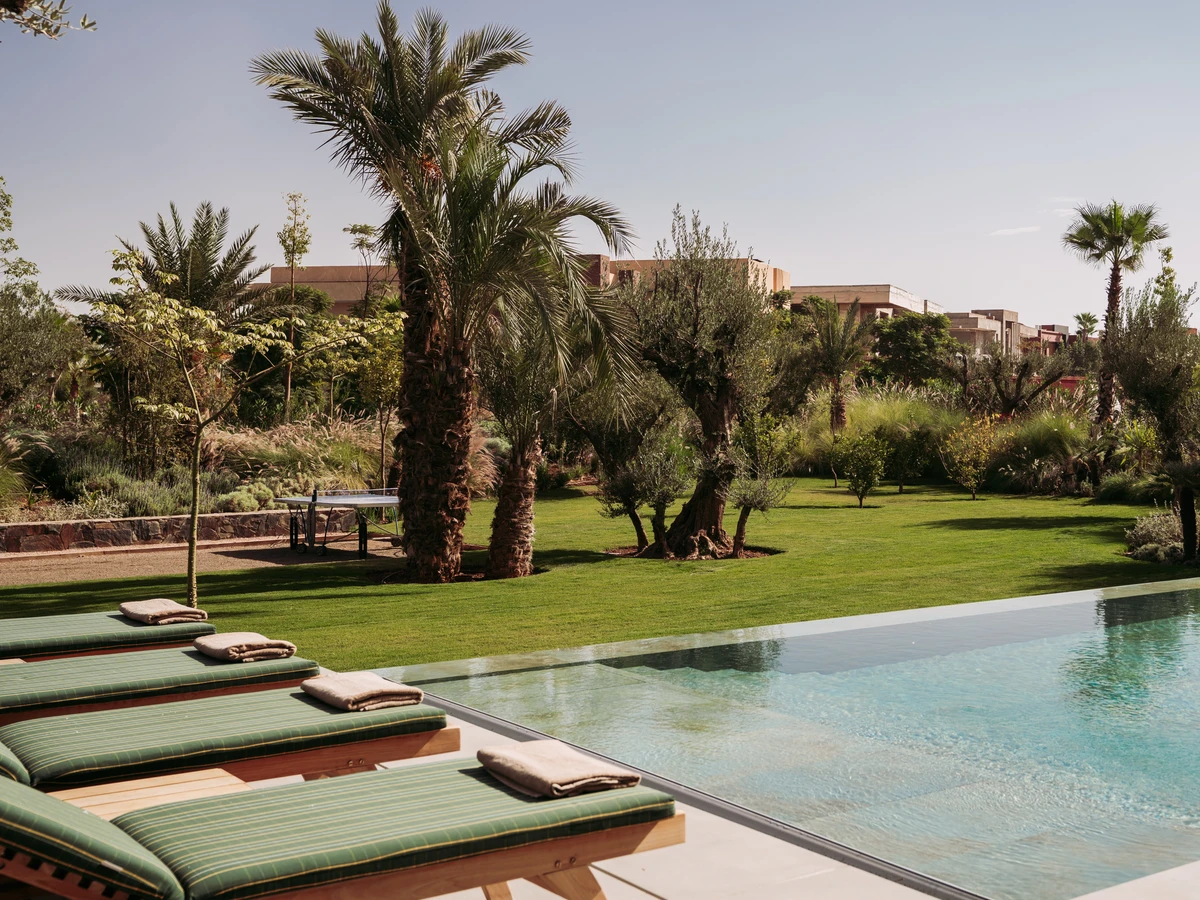
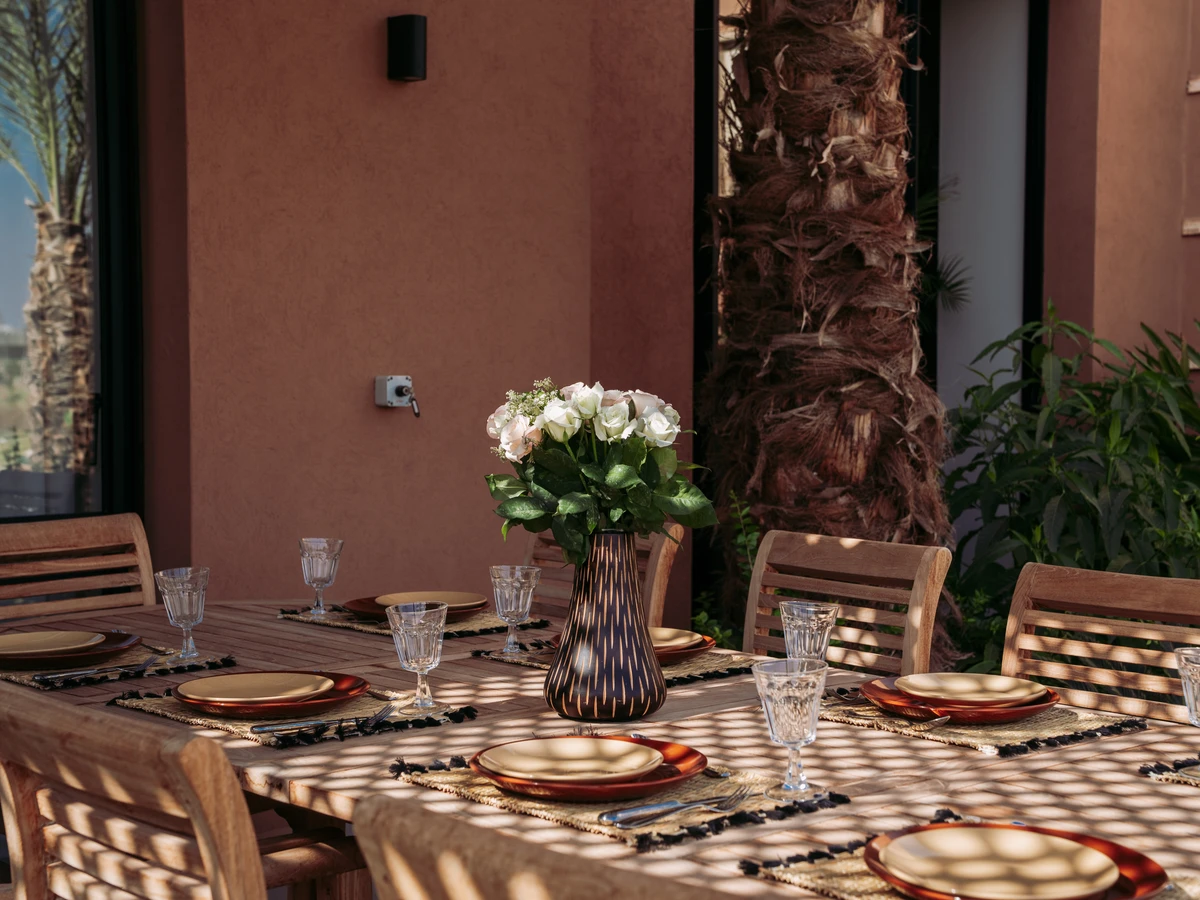
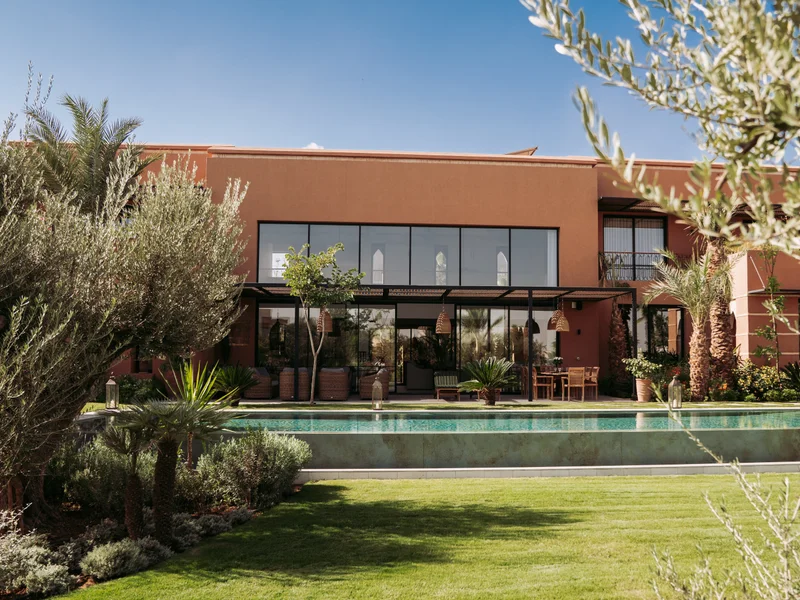
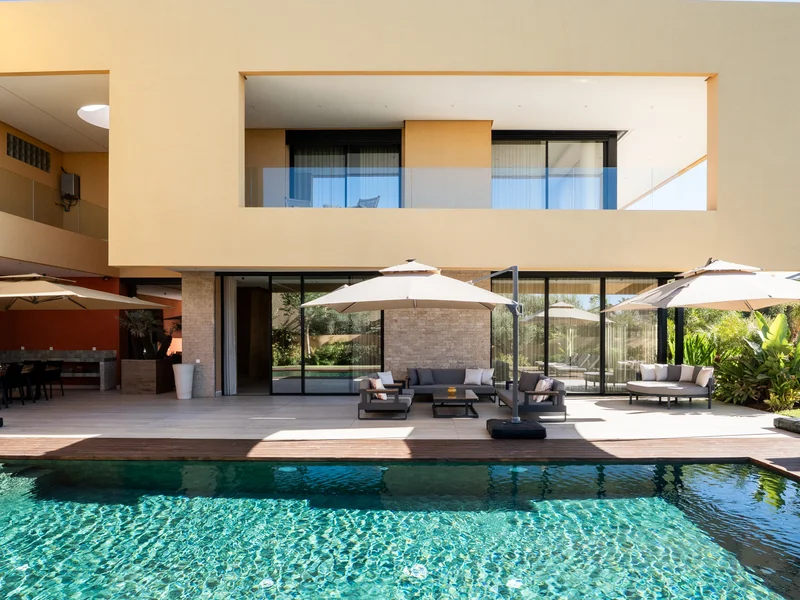
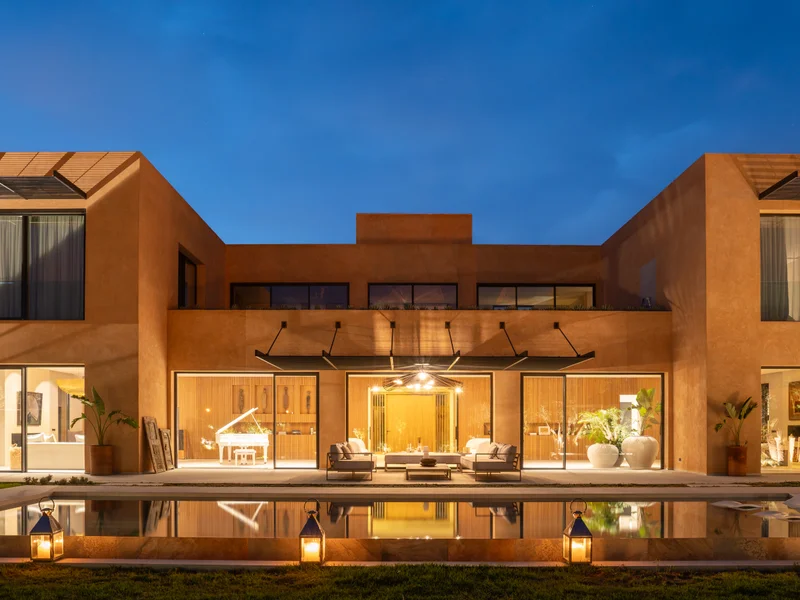
Villa 178 reads like a private members' club someone happened to build a house around. The architecture is contemporary in the European sense: terracotta facades, double-height ceilings, floor-to-ceiling glass on the garden wall, arched doorways borrowing just enough Moroccan grammar to keep the building grounded in place. Five en-suite bedrooms, six bathrooms, and a list of common-area amenities that would be excessive in a hotel: a private cinema with tiered seating, a fitness room with proper equipment (free weights, machines, mirrors), a wellness room built into the villa for in-house massages, and a heated pool with covered dining for ten.
The 2,000 m2 of grounds matter. The pool deck does not abut the next villa. The pergola is its own zone, separate from the lounge zone, separate from the garden lawn. A family of ten can spread out without anyone being on top of anyone. The cinema room is the surprise: not a TV-in-a-dark-room situation, an actual screening space, tiered seating, projector, sound, that turns into a default activity by night four when the group has done the souks twice and wants pizza and a movie.
Villa Aurea: The Art Collector's Salon
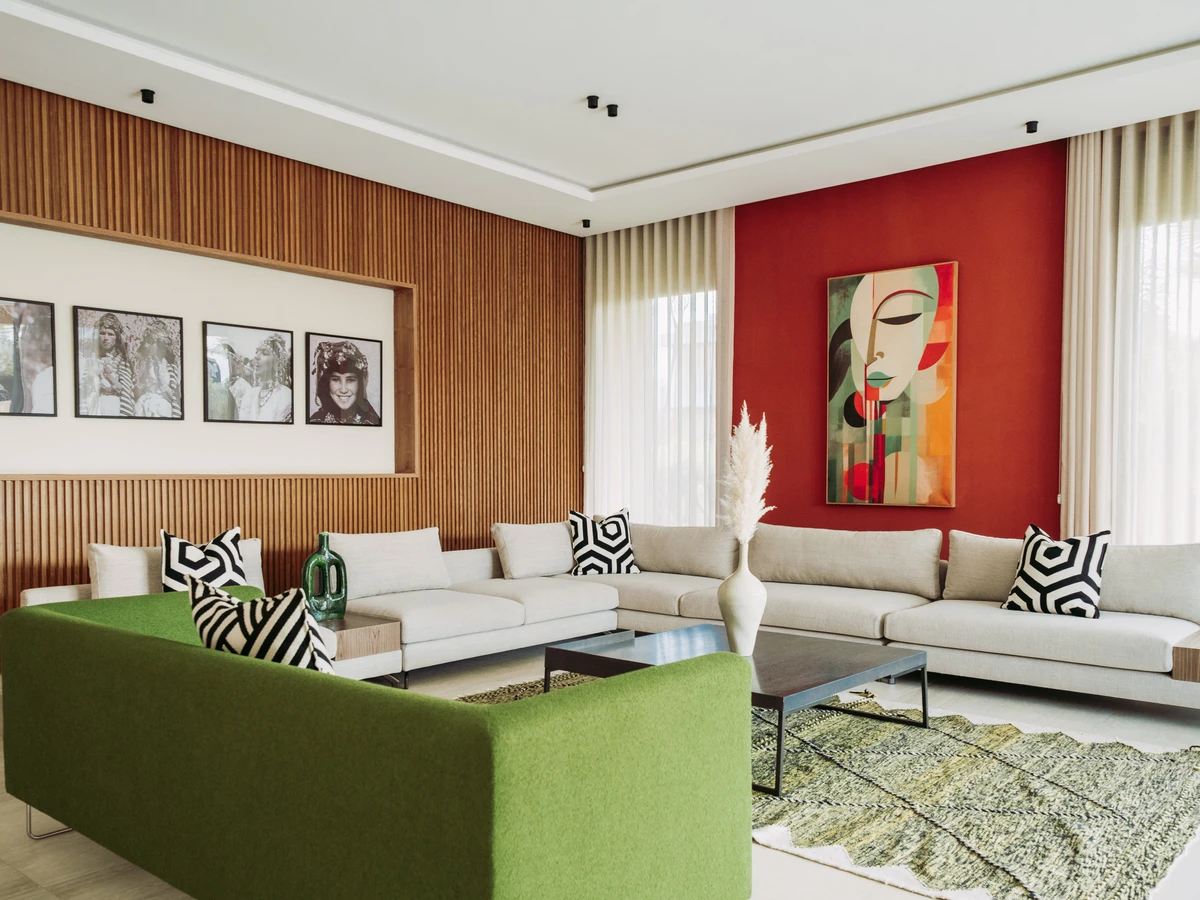
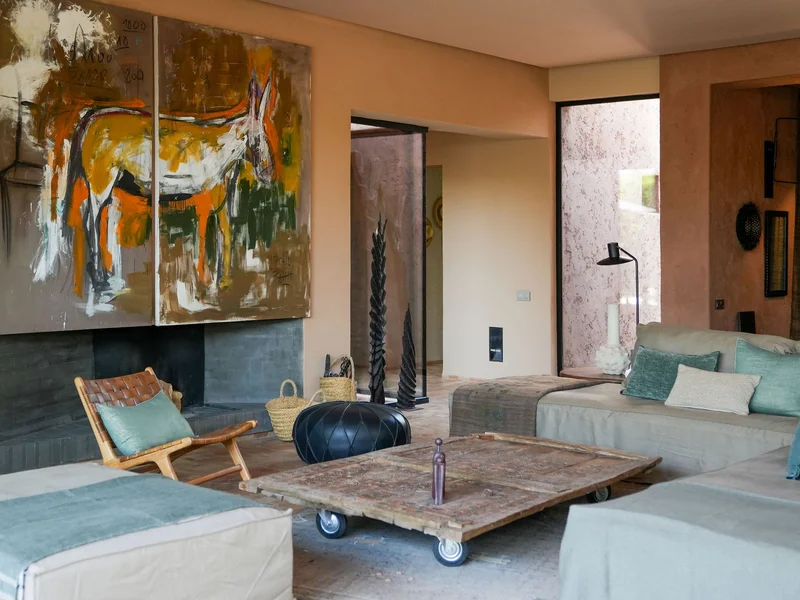
Villa Aurea is the house someone with a real art collection would build. Bold color decisions: an emerald velvet sofa staring across the salon at a red accent wall, a marble-topped dining table for 8 anchored by walnut chairs, sculptural pendant lighting throwing shapes across the tadelakt. Curated contemporary art on every major wall, not the generic abstract canvases that get rotated through rentals, actual pieces you stop in front of and look at. Five en-suite bedrooms, each with its own color story.
The big architectural moment is the fireplace in the main salon. Most Marrakech villas skip the fireplace. The winters are mild, the budget is better spent on cooling. Aurea kept it because the design needed an anchor that the eye could land on, and a working fireplace doubles as a heat source on the handful of January nights when the desert temperature dives. The room around it is a real conversation room: low Togo-style sofas, a long wooden table for grazing, lighting tuned for evening rather than for Instagram. It is the villa to book when half the group reads, half the group sketches, and the energy needs to slow down by 9 PM.
Villa Insa: The Modern White-on-White
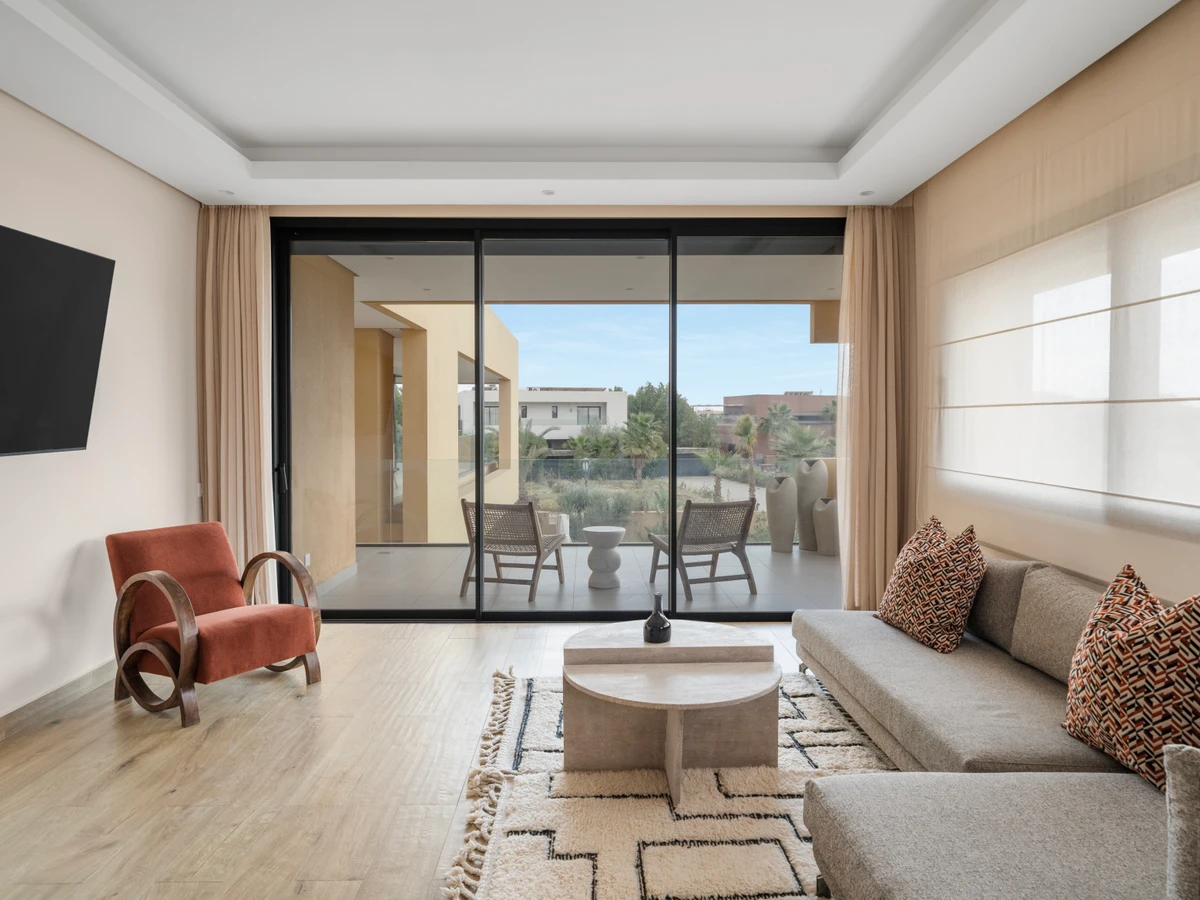
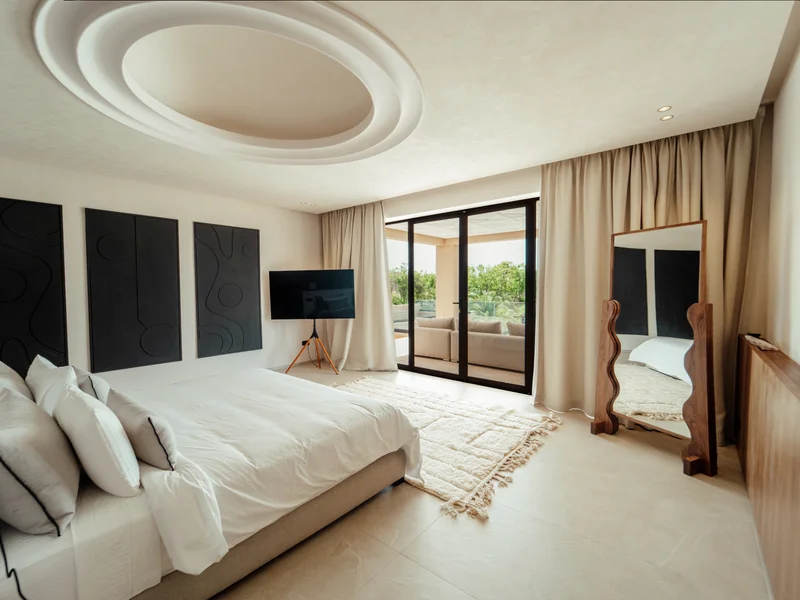
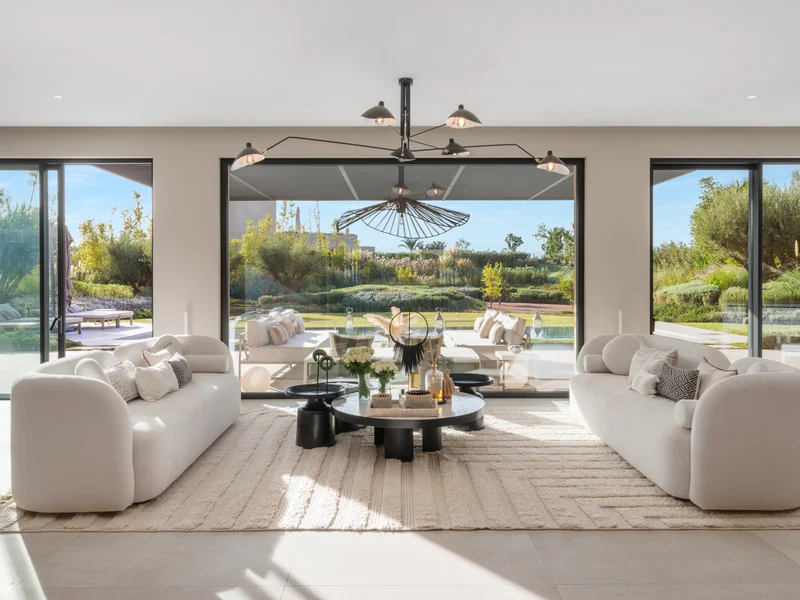
Villa Insa is the most modern of the three. Red-brick exteriors give way to a near-monochrome interior: white bouclé sofas on white tile, art-niche walls cut into the architecture for vertical pieces, globe pendants throwing soft circles of light across the hallways. Floor-to-ceiling glass frames the pool and the garden. The standout object in the living room is a white grand piano. Not a decorative one. A working instrument the owner plays when he is in residence and that guests are welcome to use. We have had musicians book the villa specifically for it, but it is also a quiet anchor in a room that otherwise reads as a gallery.
The other thing Insa solves: location. It sits at the section of Amelkis closest to central Marrakech. Jemaa el-Fna is 15 minutes by car. The Majorelle Garden and the Yves Saint Laurent Museum are 14 minutes. Compared to the more remote Fes Road estates, getting to dinner at La Trattoria or shopping in Gueliz is a short ride, not a half-hour expedition. For groups who plan to use the villa as a base and spend significant time inside the city walls, Insa is the most efficient pick.
How to Choose Between the Three
Multi-generational family (10 people, mixed ages, kids included): Villa 178. The cinema, the fitness room, and the 2,000 m2 of grounds absorb the energy of a big group.. Couples weekend with design-aware friends (8 to 10 adults, no kids): Villa Aurea. The salon and fireplace make for the slowest, most intentional evenings of the three.. Group anchored in central Marrakech (souks, museums, restaurant tour): Villa Insa. 15 minutes to the Medina is the difference between a casual dinner out and an